
“Yes!” I thought, “This is how it starts!”
My sister in law returned one afternoon last week with the
news that a member of her women’s group was looking for someone to deliver a
lecture on bees.
“I told them my brother in law is a bee expert,” she said,
“he blogs about them all the time” (sic).( As if blogging implied expertise on
anything!)
“Still,” I thought, “why not? It might be an interesting experience and it
can’t be anything that Wikipedia and I wouldn’t be able to manage together. Plus
of course it’s true, I did write a piece about neonicotinoid pesticides and how
they are destroying bee populations around the world. So today the Bangalore women’s group,
tomorrow the international lecture circuit!”
My sister in law looked slightly surprised that I was
interested, but she promised to get me more details.
“It’s a school thing.” She told me next day. “They want you to talk for 45 minutes to an
audience of 15 year olds.”
School? Alright I can
do that. Fifteen was a bit younger than
I expected, but OK, they would probably be studying environmental degradation
as part of their IB curriculum. I could
rework my research on neonicotinoids. And 45 minutes! Well I could always add a
bit about the difficulties of contamination in field trials of pesticides, discuss
political engagement in the 21st century, and maybe talk about the
whole history of bee keeping back to ancient times. It could be right up my street! My public speaking career has to start
somewhere.
The next day it changed again. “I got it slightly wrong, “she blithely
explained.” “They only want you to talk for 15 minutes, to a class of 4 and 5
year olds.”
The silence was palpable.
I have occasionally considered starting a new career as a teacher. How hard can it be? And all those holidays! But never in my
wildest imaginings did I see myself teaching in a kindergarten.
I have kids of my own, but when they were that age I was
commuting three hours each day to and from London. My main memory of 5 year olds is of kissing
their foreheads as they lay sleeping. There was one infamous birthday party that
stands out in my memory. I ended up screaming at 15 boys, who were all hitting
each other with Harry Potter wands, which I had actually made and given to
them. My wife came out to the garden with
a tray of drinks just in time to hear me bellowing at the top of my voice: "Effing
shut up and effing sit down!” I was
promptly reassigned from master of ceremonies to making egg sandwiches. “Who
arms 5 year old boys?” She asked incredulously.
So no, I did not really view this latest change to the proposed event as
a positive.
Anyway, whatever my reservations it seemed it was too late
to change my mind on the bees. “They are
really excited” my sister in law continued, “and the teacher has sent you a
list of questions from the children.”
Needless
to say there was no mention of killer pesticides or the obstructive attitudes
of EU politicians. The first question
was, “Why are bees black and yellow?”
So I dived back in to Wikipedia to do some serious research
about bees. And last Wednesday at around
10.00 A.M. I found myself in a beautiful
little garden belonging to one of the parents standing in front of a dozen or
so excited kids and a few expectant parents.
Actually it went OK. It
was in roughly equal parts an exercise in education and crowd control, but the
class teacher was on hand to deal with the worst of the cat herding and I
didn’t swear once! I over estimated my
audience by some orders of magnitude, but apart from a couple of slips into
‘camouflage’ and ‘enzyme’ I largely managed to avoid polysyllables and I kept
their attention pretty well to the end.
Interaction seemed to be both the key and the biggest
risk. On the one hand they loved doing
the ‘waggle dance’ but then I had to get them back into a sedentary position
again. Asking them to name their
favourite fruits got them engaged, apart from one little Japanese girl who said
with a sinister grin that she wanted to eat me.
So it might not have launched my public speaking career, and
it definitely convinced me that I do not want to be a kindergarten teacher, but
to be fair I had a blast, and I also learnt a lot about bees. If you are interested, the Q&A is posted
below this blog.

Why are bees
important?
Well all creatures are important. Nature
is like a jigsaw puzzle, and every part has its place. Every creature is necessary to complete the
picture.
But bees are especially
important. Yes, they make delicious honey,
but more, much more than that. When bees
go from flower to flower to gather nectar, they spread pollen which makes fruit
and vegetables grow.
What’s your favourite fruit? [We were in a garden where the children could
see mangos, coconuts, bananas, strawberries and tomatoes all growing] Well all of those fruits need bees to
pollinate them. And so do: nuts;
cabbages, broccoli and sprouts; tomatoes; peppers, chilies and other spices;
cucumbers; melons; marrows; courgettes; aubergines; avocados; tea and coffee.
In all, over 1/3 of all the world’s
food is pollinated by bees.
Why are some bees
different sizes?
Well for a start there are over 20,000
different species of bee and probably more that we don’t recognize.
Some bees live in big colonies with
tens of thousands of brothers and sisters.
While some bees live all by themselves.
Some bees make holes in rocks to make a home. We call these masonry bees. Some burrow into
wood. These are called carpenter bees.
Some bees live underground. And then there are cuckoo bees. They don’t even make their own homes, they
lay their eggs in other bee’s hives and let the workers there feed them and
bring them up. Then there are honey
bees, which are the ones we are going to look at today.
In a honey bee hive there are three
different kinds of bee.
First of all, the biggest bee is
the queen. There’s only one queen and
her job is to lay eggs. She is the
mother of all the other bees in the hive.
Then there are the worker
bees. These are the ones we usually see
flying about. The workers are all female. Girls do all the work in this house. They all have special jobs. Some go out to collect nectar and pollen.
Some stay ay home and clean the hive or look after the young ones. Others make the honey and build the hive by
making beeswax. Only the workers have a
sting.
The third kind of bees are the male
(boy) bees, the drones. They don’t go
out. They just sit around the hive all
day eating and drinking. Their job is to
make babies with the queen.
Why are bees black
and yellow?
Colour is usually used in the
animal kingdom for two reasons. Some
creatures use colour to blend into the background to hide. You know how soldiers wear camouflage to hide?
Other creatures use bright colours
to stand out and be seen. To most
animals yellow and black means danger. Some
poisonous snakes and frogs are yellow and black. We use yellow and black on
road signs or as warnings on dangerous buildings to tell people to be careful.
Bees are basically saying “Look at me! I’m dangerous! Don’t eat me!
You won’t like it!”
If you did ever eat a bee you would
remember it, and next time you saw a yellow and black creature you would avoid
it. Right?
Why do bees buzz?
Bees have to flap their wings to
fly. They flap them very fast at 11,000
times per minute, which is why it sounds like they are "buzzing".

How do bees make
honey?
To begin with flowers make nectar
to attract the bees. Remember, flowers
need bees to visit them to help pollinate them, so they give the bees something
in return. Nectar is rich in sugar. If
you ever eat flowers they sometimes taste sweet.
Worker bees visit the flowers and
suck up the nectar through their long, tube-like tongues. Bees have two
stomachs. As well as a normal stomach
like we have, they have something called a honey stomach. This is where they collect nectar and pollen
from flowers in their honey stomachs.
Honeybees must visit between 100
and 1500 flowers in order to fill their honey stomachs. They can carry almost their own weight in
nectar.
The honeybees return to the hive
and pass the nectar onto other worker bees from mouth to mouth. These
"house bees" chew the nectar for about half an hour. While they do
that, special chemicals in their spit called enzymes get mixed with the nectar
and this helps make the honey. Then they spit it into the honeycombs and dry it
by beating their wings.
Why do bees make
honey for us?
They don’t. They make it for
themselves. They feed it to their babies
to make them grow big, and in the winter when there aren’t many flowers
blooming, the bees all stay in the hive and huddle together to keep warm, and
they eat the honey they made in the summer.
In one year, a colony of bees eats
between 50 and 100 kg of honey.
Humans are just one of a long list
of other animals that like to eat honey. Can you think of some others? Badgers, bears, civets, honey badgers, jackals,
monkeys, possums, raccoons, skunks and even little mice all steal honey from
bees.
Why do bees make wax
to cover the nectar?
Beeswax is strong, sterile,
airtight, easy to work with and they can make it themselves. It’s the perfect material for bees to make
honeycomb. Worker bees make beeswax from
glands in their heads.
We used to use beeswax for all
kinds of things like making candles and wood polish. Even today some of the most expensive
lipsticks are made with beeswax.
To produce their wax, bees have to
eat about eight times as much honey by mass. So to make one kilogram of beeswax
the bees need to eat 8 kilograms of honey.
Imagine how long it takes to collect enough nectar to make 8kg honey and
how far the bees have to fly from flower to flower to gather it. Well, if only one little bee had to do that
all by herself it would be the same as if she flew right around the world 12
times!
Bees collectively fly 500,000 km,
roughly 12 times around the earth, to yield one kg of beeswax.
How do they find the
flowers?
How do you find flowers? With your eyes and maybe with your
noses. Well bees are the same. Flowers
give off scent to attract bees. Can you
smell the lovely frangipani? [We were in
a garden.] Well that perfume is not really for our benefit, it’s to attract
bees. Remember flowers need bees to pollinate them.
Bees are only able to see blue,
green and violet. But they can see a different type of light known as ultraviolet
light, which is invisible to the human eye.
Ultraviolet, or UV light, comes from the sun. When UV light reflects off
yellow or white flowers it makes them look purple or violet to bees.
Scout bees go looking for new
places to find nectar and when they find a bush covered in flowers they fly
back to the hive and tell the others. They tell the other bees in the hive where
to go by performing a ‘waggle dance’. The scout bee goes round and round in a
big number 8, and every now and then she waggles her bottom to tell the other
bees how far away the flowers are. The
more she waggles, the further they need to fly.
When they’ve got the information, the other bees all fly off to the bush
and start collecting the nectar.
When do bees hunt for
nectar?
Ultraviolet light comes from the
sun so bees go looking for nectar on sunny days. If the sun isn’t shining they don’t bother.
However some flowers only give off
scent in twilight, and there are some bees that know this and they only go out
as dusk to find them.
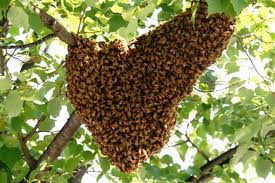
What happens when the
hive gets too big and there are too many bees living there?
At some stage the queen decides the
time has come to start a new hive. The
worker bees make special honeycomb cells called queen cups, and when the queen
is ready she lays eggs in the queen cups and then flies out of the hive. It’s the only time she ever leaves the hive.
About half the workers, tens of
thousands of them, follow her and they usually settle on a nearby tree or
wall. This is called a ‘swarm’. It can look scary but the bees aren’t really
dangerous because all they want is to find a new home.
When the queen choses a new place,
her followers all start to build a new hive around her, and when it’s ready she
starts laying eggs again and a new hive is established.
Meanwhile, back in the old hive the
eggs in the queen cups hatch. The worker bees that stayed behind start feeding
the babies with a special food called ‘royal jelly’. This makes the babies grow up as new
queens. One of these princesses will
then become the new queen of the old hive.
How long do bees
live?
Queen bees will live for 4 or 5
years.
Workers only live for about 6 or 8
weeks. That’s why the queen needs to lay
so many eggs to make sure there are always lots of new workers for the hive.
In cold countries, in winter,
worker bees can slow their bodies down so that they live longer.


