Showing posts with label Bees. Show all posts

Wednesday, 24 April 2013

Bee in my Bonnet


I don’t like to go on, but this is an issue that simply refuses to lie down.

The plot so far.

You may remember that last month Britain and Germany abstained in a crucial EU vote which aimed to introduce restrictions on the use of neonicotinoid pesticides which have been widely implicated in killing bees and other pollinators.  The proposal for a two year ban on the use of neonics on a range of specific crops, followed advice received by the European Food Safety Authority. (EFSA)  The details are in my earlier blog “The Plight of the Humble Bee”.

The position of Britain’s Owen Paterson, the Secretary for Environment, Food and Rural Affairs, is that the science is inconclusive, the cost benefits analysis unclear and he intends to wait for DEFRA’s own trials before making any commitments.

That sounds reasonable.

Prof. Ian Boyd
However Paterson’s own chief scientific advisor, Prof. Ian Boyd of St Andrew’s University, admits that insufficient testing has been carried out to inform a proper cost benefit analysis.  He agrees that in twenty years of use, it is unacceptable that that the manufacturers have not published clear data one way or the other.  In fact the agrochemicals companies who make neonics have spent a fortune trying to prove that bee decline is primarily caused by the parasitic varroa mite.  Meanwhile a growing number of peer reviewed research reports do support the view that neonicotinoids are a major factor in pollinator decline.

But is a cost-benefit analysis the appropriate way to go about this?  How do you compare the financial benefit of biodiversity with the costs of implementing bans or restrictions?  Actually, The Scottish Wildlife Trust, which supports the ban, does try to do just that.  “Bees and other pollinating insects play a vital role in food production, worth approximately £43 million/yr to Scotland’s economy.”  Obviously the figure for the entire UK would be several times greater than that.  Although they also point out that “Most… plant communities rely on pollinating insects to reproduce and therefore spread. They also form a vital part of the food chain for other species such as birds, reptiles and amphibians. It follows that any insecticide that drastically reduces pollinator numbers will have effects beyond the agricultural sector and will ultimately affect the health and function of entire ecosystems.”

And what of DEFRA’s own trials, referred to by Mr. Paterson?  On 27th February, Prof. Boyd gave evidence to the UK Environmental Audit Committee at which he admitted that their field trials had been seriously compromised by contamination from neonicotinoids and stated that at the control site of the bumblebee study, there were residues of neonicotinoids in pollen and nectar.  In other words, bees range so widely to find nectar, that it was impossible to isolate a colony from the effects of these insecticides in order to conduct comparative trials.  Surely that highlights the scale of the problem and reinforces the need for restrictions as the only way to assess the impact of neonics?

Currently, Prof Boyd conceded, there are no relevant trials in the pipeline which might influence DEFRA’s stance.

Are we sure neonicotinoids are to blame?

 PAN, The Pesticide Action Network, which also unsurprisingly supports the ban, is very clear.

Honey bee losses and population declines are certainly multi-factored, [their bold] involving reduction in adequate and good quality foraging sources, habitat degradation, reduced immune system defences to parasites and diseases, as well as increased exposure to neonicotinoids.”   But doesn’t that make it all the more important that we do what we can to avoid needlessly adding to the problem.


Plus other circumstantial evidence also points towards neonics as a major culprit.

Colony Collapse Disorder was first noticed within two or three years of neonics being introduced.

Many species of wild bee and other pollinators have also seen catastrophic population declines over this period and they are not susceptible to varroa mites.

Italy introduced a ban on seed treatment of maize by three neonicotinoids in Autumn 2008.  At the same time, the Italian Ministry of Agriculture set up APENET as the official monitoring agency for the trials.  Since the ban no cases of hive collapse have been reported in the crucial Spring sowing period, compared with 185 cases in the preceding year.  And Winter losses, always a factor in beekeeping, have also declined from 37.5% in 2008 to 15% in 2011, indicating an all round improvement in bee health.

So where are we now?

Mr Paterson’s problem is that his orders from the Prime Minister are unequivocal.  “Don’t do anything that might damage economic growth.”  Syngenta, one of the two major manufacturers of neonicotinoids, employs 2,000 people in the UK and Ireland.  The other big manufacturer is Bayer and Germany joined the UK in abstaining in last month’s vote.  Quite clearly, Paterson is putting short term economic expediency ahead of the long term health of the environment.

Fortunately, it is not too late for the Secretary of State to make amends.  Next week, on April 29th, the EU Commissioner for Health & Consumer Policy, Tonio Borg, will take his case to the European Commission's Appeal Committee.  He is entitled to do this since there was no overall majority of the 27member states.  Mr. Borg deserves much credit for retaining his proposal intact and refusing to water it down in the face of intense lobbying by the chemicals industry.

Currently, Mr. Paterson is saying publicly that he will oppose the ban.  But the temperature is rising on all sides.

On March 20th, immediately following his abstention, the minister complained of a cyber attack when he received over 80,000 emails demanding he take action to help bees.

On April 3rd, the influential, cross party Parliamentary Environmental Audit Committee issued a report accusing DEFRA of ‘extraordinary complacency’ in this matter.  The Department, it said, was relying on ‘fundamentally flawed’ studies and failing to uphold its own precautionary principle. It continued, "We believe that the weight of scientific evidence now warrants precautionary action."

Further influential reports published by Greenpeace (Bees in Decline) April 9th, and one by a team of 40 scientists from 27 institutions published in the scientific journal Frontiers in Ecology and the Environment, on April 22 both demanded coordinated action to help bee populations.

Last week, as reported on this blog, the supermarket chain, Waitrose, introduced its own ban on produce from farms using neonicotinoids.

Yesterday, the Bulgarian Prime Minister, Marin Raykov, announced that his country would be changing its position to support the ban.  Addressing a protest rally of beekeepers from all over Bulgaria he stated,  If we fail to pay attention to the problem with bees today, tomorrow we shall have nothing to eat,".


In the UK, Internet lobby group 38 Degrees will deliver a petition signed by 250,000 people to Owen Paterson tomorrow, and this will be followed on Friday by a march on Parliament jointly organized by Avaaz, Buglife, Environmental Justice Foundation, Friends of the Earth, Greenpeace, Pesticide Action Network UK, RSPB, and the Soil Association.

Mr. Paterson’s record on green issues is not encouraging.  Apart from failing to protect pollinators, he has personally lobbied to loosen restrictions on GMO use across the EU, he has made some very unfortunate comments about birds of prey, he is ploughing ahead with the badger cull in the face of mounting public and scientific opposition, and his department has completely fumbled the ball on implementing Marine Conservation Zones.  Does he now want to go down as the man who destroyed Europe’s agricultural sector by killing all our bees?

Friday, 19 April 2013

Busy Bees


“Yes!” I thought, “This is how it starts!”

My sister in law returned one afternoon last week with the news that a member of her women’s group was looking for someone to deliver a lecture on bees.

“I told them my brother in law is a bee expert,” she said, “he blogs about them all the time” (sic).( As if blogging implied expertise on anything!)

“Still,” I thought, “why not?  It might be an interesting experience and it can’t be anything that Wikipedia and I wouldn’t be able to manage together. Plus of course it’s true, I did write a piece about neonicotinoid pesticides and how they are destroying bee populations around the world.  So today the Bangalore women’s group, tomorrow the international lecture circuit!”

My sister in law looked slightly surprised that I was interested, but she promised to get me more details.

“It’s a school thing.” She told me next day.  “They want you to talk for 45 minutes to an audience of 15 year olds.”

School?  Alright I can do that.  Fifteen was a bit younger than I expected, but OK, they would probably be studying environmental degradation as part of their IB curriculum.  I could rework my research on neonicotinoids. And 45 minutes! Well I could always add a bit about the difficulties of contamination in field trials of pesticides, discuss political engagement in the 21st century, and maybe talk about the whole history of bee keeping back to ancient times.  It could be right up my street!  My public speaking career has to start somewhere.

The next day it changed again.  “I got it slightly wrong, “she blithely explained.” “They only want you to talk for 15 minutes, to a class of 4 and 5 year olds.”

The silence was palpable.  I have occasionally considered starting a new career as a teacher.  How hard can it be?  And all those holidays! But never in my wildest imaginings did I see myself teaching in a kindergarten.

I have kids of my own, but when they were that age I was commuting three hours each day to and from London.  My main memory of 5 year olds is of kissing their foreheads as they lay sleeping. There was one infamous birthday party that stands out in my memory. I ended up screaming at 15 boys, who were all hitting each other with Harry Potter wands, which I had actually made and given to them.  My wife came out to the garden with a tray of drinks just in time to hear me bellowing at the top of my voice: "Effing shut up and effing sit down!”  I was promptly reassigned from master of ceremonies to making egg sandwiches. “Who arms 5 year old boys?” She asked incredulously.  So no, I did not really view this latest change to the proposed event as a positive.

Anyway, whatever my reservations it seemed it was too late to change my mind on the bees.  “They are really excited” my sister in law continued, “and the teacher has sent you a list of questions from the children.” 

Needless to say there was no mention of killer pesticides or the obstructive attitudes of EU politicians.  The first question was, “Why are bees black and yellow?”

So I dived back in to Wikipedia to do some serious research about bees.  And last Wednesday at around 10.00 A.M.  I found myself in a beautiful little garden belonging to one of the parents standing in front of a dozen or so excited kids and a few expectant parents.

Actually it went OK.  It was in roughly equal parts an exercise in education and crowd control, but the class teacher was on hand to deal with the worst of the cat herding and I didn’t swear once!  I over estimated my audience by some orders of magnitude, but apart from a couple of slips into ‘camouflage’ and ‘enzyme’ I largely managed to avoid polysyllables and I kept their attention pretty well to the end.

Interaction seemed to be both the key and the biggest risk.  On the one hand they loved doing the ‘waggle dance’ but then I had to get them back into a sedentary position again.  Asking them to name their favourite fruits got them engaged, apart from one little Japanese girl who said with a sinister grin that she wanted to eat me.

So it might not have launched my public speaking career, and it definitely convinced me that I do not want to be a kindergarten teacher, but to be fair I had a blast, and I also learnt a lot about bees.  If you are interested, the Q&A is posted below this blog.


Why are bees important?
Well all creatures are important. Nature is like a jigsaw puzzle, and every part has its place.  Every creature is necessary to complete the picture.
But bees are especially important.  Yes, they make delicious honey, but more, much more than that.  When bees go from flower to flower to gather nectar, they spread pollen which makes fruit and vegetables grow.
What’s your favourite fruit?  [We were in a garden where the children could see mangos, coconuts, bananas, strawberries and tomatoes all growing]  Well all of those fruits need bees to pollinate them.  And so do: nuts; cabbages, broccoli and sprouts; tomatoes; peppers, chilies and other spices; cucumbers; melons; marrows; courgettes; aubergines; avocados; tea and coffee.
In all, over 1/3 of all the world’s food is pollinated by bees.

Why are some bees different sizes?
Well for a start there are over 20,000 different species of bee and probably more that we don’t recognize.
Some bees live in big colonies with tens of thousands of brothers and sisters.  While some bees live all by themselves.  Some bees make holes in rocks to make a home.  We call these masonry bees. Some burrow into wood.  These are called carpenter bees. Some bees live underground. And then there are cuckoo bees.  They don’t even make their own homes, they lay their eggs in other bee’s hives and let the workers there feed them and bring them up.  Then there are honey bees, which are the ones we are going to look at today.
In a honey bee hive there are three different kinds of bee.
First of all, the biggest bee is the queen.  There’s only one queen and her job is to lay eggs.  She is the mother of all the other bees in the hive.
Then there are the worker bees.  These are the ones we usually see flying about.  The workers are all female.  Girls do all the work in this house.  They all have special jobs.  Some go out to collect nectar and pollen. Some stay ay home and clean the hive or look after the young ones.  Others make the honey and build the hive by making beeswax.  Only the workers have a sting.
The third kind of bees are the male (boy) bees, the drones.  They don’t go out.  They just sit around the hive all day eating and drinking.  Their job is to make babies with the queen.

Why are bees black and yellow?
Colour is usually used in the animal kingdom for two reasons.  Some creatures use colour to blend into the background to hide.  You know how soldiers wear camouflage to hide?
Other creatures use bright colours to stand out and be seen.  To most animals yellow and black means danger.  Some poisonous snakes and frogs are yellow and black. We use yellow and black on road signs or as warnings on dangerous buildings to tell people to be careful. Bees are basically saying “Look at me! I’m dangerous!  Don’t eat me!  You won’t like it!”
If you did ever eat a bee you would remember it, and next time you saw a yellow and black creature you would avoid it. Right?

Why do bees buzz?
Bees have to flap their wings to fly.  They flap them very fast at 11,000 times per minute, which is why it sounds like they are "buzzing".


How do bees make honey?
To begin with flowers make nectar to attract the bees.  Remember, flowers need bees to visit them to help pollinate them, so they give the bees something in return. Nectar is rich in sugar.  If you ever eat flowers they sometimes taste sweet.
Worker bees visit the flowers and suck up the nectar through their long, tube-like tongues. Bees have two stomachs.  As well as a normal stomach like we have, they have something called a honey stomach.  This is where they collect nectar and pollen from flowers in their honey stomachs.
Honeybees must visit between 100 and 1500 flowers in order to fill their honey stomachs.  They can carry almost their own weight in nectar.
The honeybees return to the hive and pass the nectar onto other worker bees from mouth to mouth. These "house bees" chew the nectar for about half an hour. While they do that, special chemicals in their spit called enzymes get mixed with the nectar and this helps make the honey. Then they spit it into the honeycombs and dry it by beating their wings.

Why do bees make honey for us?
They don’t. They make it for themselves.  They feed it to their babies to make them grow big, and in the winter when there aren’t many flowers blooming, the bees all stay in the hive and huddle together to keep warm, and they eat the honey they made in the summer.
In one year, a colony of bees eats between 50 and 100 kg of honey.
Humans are just one of a long list of other animals that like to eat honey.  Can you think of some others?  Badgers, bears, civets, honey badgers, jackals, monkeys, possums, raccoons, skunks and even little mice all steal honey from bees.

Why do bees make wax to cover the nectar?
Beeswax is strong, sterile, airtight, easy to work with and they can make it themselves.  It’s the perfect material for bees to make honeycomb.  Worker bees make beeswax from glands in their heads.
We used to use beeswax for all kinds of things like making candles and wood polish.  Even today some of the most expensive lipsticks are made with beeswax.
To produce their wax, bees have to eat about eight times as much honey by mass. So to make one kilogram of beeswax the bees need to eat 8 kilograms of honey.  Imagine how long it takes to collect enough nectar to make 8kg honey and how far the bees have to fly from flower to flower to gather it.  Well, if only one little bee had to do that all by herself it would be the same as if she flew right around the world 12 times!
Bees collectively fly 500,000 km, roughly 12 times around the earth, to yield one kg of beeswax.

How do they find the flowers?
How do you find flowers?  With your eyes and maybe with your noses.  Well bees are the same. Flowers give off scent to attract bees.  Can you smell the lovely frangipani?  [We were in a garden.] Well that perfume is not really for our benefit, it’s to attract bees. Remember flowers need bees to pollinate them.
Bees are only able to see blue, green and violet. But they can see a different type of light known as ultraviolet light, which is invisible to the human eye.  Ultraviolet, or UV light, comes from the sun. When UV light reflects off yellow or white flowers it makes them look purple or violet to bees. 
Scout bees go looking for new places to find nectar and when they find a bush covered in flowers they fly back to the hive and tell the others. They tell the other bees in the hive where to go by performing a ‘waggle dance’. The scout bee goes round and round in a big number 8, and every now and then she waggles her bottom to tell the other bees how far away the flowers are.  The more she waggles, the further they need to fly.  When they’ve got the information, the other bees all fly off to the bush and start collecting the nectar.

When do bees hunt for nectar?
Ultraviolet light comes from the sun so bees go looking for nectar on sunny days.  If the sun isn’t shining they don’t bother.
However some flowers only give off scent in twilight, and there are some bees that know this and they only go out as dusk to find them.


What happens when the hive gets too big and there are too many bees living there?
At some stage the queen decides the time has come to start a new hive.  The worker bees make special honeycomb cells called queen cups, and when the queen is ready she lays eggs in the queen cups and then flies out of the hive.  It’s the only time she ever leaves the hive.
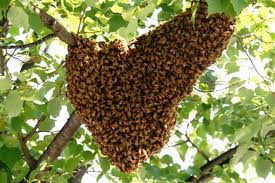
About half the workers, tens of thousands of them, follow her and they usually settle on a nearby tree or wall.  This is called a ‘swarm’.  It can look scary but the bees aren’t really dangerous because all they want is to find a new home.
When the queen choses a new place, her followers all start to build a new hive around her, and when it’s ready she starts laying eggs again and a new hive is established.
Meanwhile, back in the old hive the eggs in the queen cups hatch. The worker bees that stayed behind start feeding the babies with a special food called ‘royal jelly’.  This makes the babies grow up as new queens.  One of these princesses will then become the new queen of the old hive.

How long do bees live?
Queen bees will live for 4 or 5 years.
Workers only live for about 6 or 8 weeks.  That’s why the queen needs to lay so many eggs to make sure there are always lots of new workers for the hive.
In cold countries, in winter, worker bees can slow their bodies down so that they live longer.
 

Friday, 12 April 2013

Aisles of Plenty


No subject may be counted upon to get people worked up into a good righteous lather more than supermarkets.  Supermarkets have transformed our lives in the past forty years like few other modern institutions.  But to many people they are the epitome of evil.  Campaigners the length and breadth of the country fight to keep these commercial behemoths out of their communities.  They are charged with causing or enabling every kind of social and environmental problem we face.

Supermarkets, it is claimed, destroy our towns by using their scale to drive small businesses out of the market, leading to decimated high streets which then fill up with estate agents, betting shops and charity shops.  They damage our rural environment by using their buying power to squeeze producers to the point that they have to focus entirely on price without regard to the damage such practices may have on ecology. They add food miles to our daily grocery basket. They create an economic model where it profits unscrupulous producers to substitute horsemeat for the er… ‘prime beef’ people thought went in to their economy burgers. They manipulate world prices and bully third world countries.  They force shop workers to work nights and on weekends, breaking down age old religious and social traditions such as the day of rest.  They promote cheap alcohol sales which cause social problems, particularly among the young, and so on and on.

All of these claims have more than a grain of truth behind them, but despite the fact that nobody admits to liking them, we all shop in them.  Almost every family in Britain must hold a loyalty card for one or more of the big four chains.  (Big 4?  There’s another problem, they eliminate competition from the market!)

Of course they wouldn’t be popular if they weren’t doing something right.  There are flip sides to most of these arguments. Supermarkets have largely been responsible for the era of low food prices enjoyed by consumers for decades.  Like their advertisements say, they do scour the world for interesting and unusual products.  This alone has driven the food revolution in modern Britain transforming our national cuisine from a standing joke to a showcase of the world’s finest fare.  And many hard pressed consumers are glad to be able to do their shopping at night or on Sundays.  For one thing, I know from my own experience, it allows fathers to play a more complete part in family life.

The point is that supermarkets by themselves are neither good nor bad.  They do, as a function of their size, wield great power.  That power can be used for good or for ill, as I alluded to some weeks ago at the height of the horse meat scandal.

Today, my eye was caught by two stories which illustrate this point exactly.


First Tesco has announced that they will drop an eleven year old restriction on chickens and eggs from birds fed on GM soya.  They claim that it is simply becoming too hard to source non-GM chicken feed.  Equally significantly, they do not plan to label chickens or eggs as GM products.  The Soil Association dispute Tesco’s arguments about sourcing feed and say in effect that the supermarket is being pressured by big, multinational, industrial farm corporations.

I have avoided blogging about genetic modification because it’s a huge and complicated subject.  Frankly I don’t think we yet know all the facts.  Personally I am not particularly worried about eating GM produce, but I am concerned about the possible effects on wildlife and natural flora, and I don’t like the idea of farmers being locked in to particular agrochemicals suppliers.  Stories of Frankenstein foods don’t help, but then neither do real world examples of Monsanto trying to patent common fruit and vegetables.

Faced with such uncertainty my natural response is to rely upon the precautionary principle and do nothing irrevocable. GM foods exist.  Let them be properly labeled and allow the consumer to decide.  All the evidence shows that the public is not happy about eating GM produce.  By their actions Tesco is taking the decision and the choice away from the consumer.


.
On a more positive note, Waitrose has today instituted a ban on neonicotinoid pesticides because of concerns over the harm done to bees, butterflies and other pollinators.  I blogged about these systemic insecticides three weeks ago, and how Germany and the UK, homes respectively to the two biggest manufacturers, Bayer and Syngenta, blocked EU wide restrictions on their use.

Under Waitrose’s Seven Point Plan for Pollinators, suppliers of fruit, vegetables, flowers and commodity crops such as oilseed rape have until the end of next year to stop using the three most popular neonicotinoids: imidacloprid, clothianidin and thiamethoxam.

In parallel with this ban, the supermarket will fund a three year research programme at the University of Exeter to establish the facts about these chemicals, which are naturally disputed by the manufacturers.

Perhaps like me you feel it should have been the chemicals companies themselves or even DEFRA which sponsored this research, but nevertheless I welcome Waitrose‘s unilateral action.

Examples such as these demonstrate how supermarkets can use their power in the interest of the consumers or against them in the narrow pursuit of profit at all costs.  They also remind us that there is always a choice, even if we have to drive a little further to get it.

* Morrisons and Asda had both previously dropped their own bans on GM feed.  Marks & Spencer, The Co-Op and Sainsbury’s  all followed Tesco's lead within hours of my writing this blog.